SIGNATURE & DISCLOSURE
A signature alone does not prove what was explained.
DIGITAL INFORMED CONSENT FOR HOSPITALS
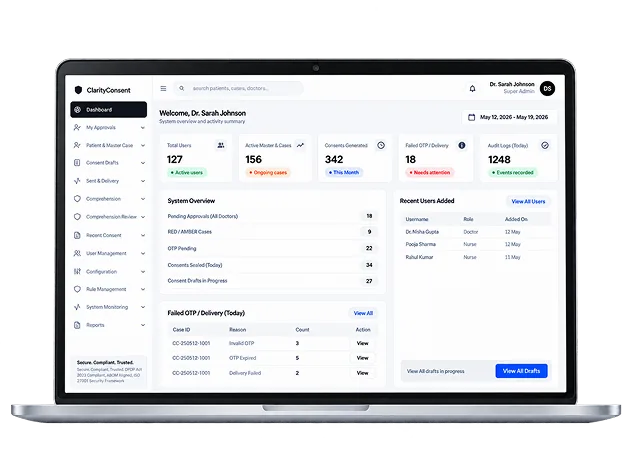
ClarityConsent helps doctors and hospitals create stronger informed-consent records—with clear communication, verified patient understanding and an auditable trail that remains available for future review.
 BUILT BY DOCTORS WITH MORE THAN

THE PROBLEM
Doctors already spend valuable time explaining procedures, risks and alternatives. Yet traditional consent processes can still leave hospitals with inconsistent documentation, patient misunderstanding and difficult-to-defend records.
What must also be demonstrated?
A signature alone does not prove what was explained.

Confirm that the patient understood—not merely read—the information.

Present consistent, procedure-specific risks, benefits and alternatives.

Maintain clear, time-stamped evidence of every important interaction.
Our Approach
Capture relevant patient, procedure and clinical information.
Identify applicable risks, benefits and alternatives using approved clinical rules.
The doctor reviews, personalizes and approves the information.
Provide a clear explanation in the patient’s preferred language and format.
Preserve a complete, secure and time-stamped consent history.
BUILT FOR YOU
AI assists. Rules validate. Doctors decide.





FOR PATIENTS
When patients understand the reasoning, they make more confident decisions.
Better conversations. Safer care.
GOVERNANCE & RISK MANAGEMENT
 Information presentedWhat information was shared with the patient?→
 Patient questionsWhat questions or concerns did the patient raise?→
 Understanding verifiedHow was the patient’s comprehension checked?→
 Clinician reviewWho reviewed and approved the final explanation?→
 Consent recordedWhen and how was final consent provided?→
 Audit trail preservedA complete timeline of every important step.→
OUR FOUNDER
ClarityConsent grew out of real hospital practice and the everyday realities of how informed consent actually happens.


OPERATIONAL VALUE
ClarityConsent helps healthcare organizations standardize repeatable consent activities so clinical and administrative teams can spend less time managing paperwork and fragmented records.

Reduce repetitive explanations and unnecessary administrative steps.

Minimize printing, scanning, physical storage and manual filing.

Better structured documentation means less effort reconstructing incomplete records later.

Give teams one repeatable workflow across departments.

Access organized consent documentation when needed.

Standardize processes across doctors, departments and multiple facilities.
DESIGNED FOR CLINICAL PRACTICE
ClarityConsent can support consent workflows across different specialties and procedures.

High-risk pregnancy, TOLAC, Caesarean section and procedural consent.

Procedure-specific information, risks, alternatives and pre-operative consent.

Structured communication around anaesthetic procedures and risks.

Consent for invasive diagnostic and therapeutic procedures.

Support for complex clinical decisions requiring stronger documentation.

Configure consent processes according to departmental requirements.

A safer, more transparent and more efficient approach to informed consent, helping healthcare teams improve patient understanding, reduce administrative burden, and maintain stronger documentation.
SEE IT IN ACTION
Discover how ClarityConsent can help your organization improve patient communication, reduce administrative burden, standardize consent workflows and create stronger documentation.